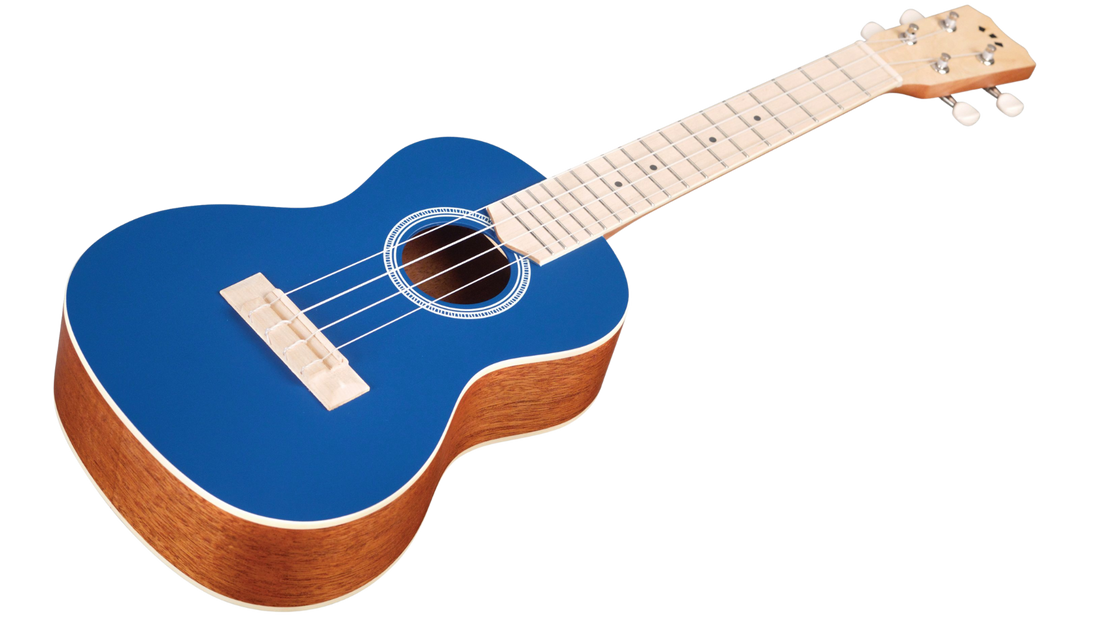
C and D tuning - Part 1 - Background:
The story of why and when the ukulele has its tuning sounds a little different depending on who you hear it from. Many people believe that one mood is right and the other wrong, and so it affects the story being told. I personally believe that there is no right or wrong. On the other hand, the different moods have their places and situations where they fit differently well. To understand how things are connected, one must know something about the history of the ukulele.
Here follows an extremely concise and simplified version.
The ukulele was born in Hawaii at the very beginning of the 20th century. Portuguese sailors and colonizers brought a Portuguese instrument there called the cavaquinho.
The king of Hawaii was delighted with the small instrument and decided that it should become Hawaii's national instrument. Then the ukulele was born.
The ukulele probably already existed from the start in different designs and sizes, in the same way as the cavaquinho. But the soprano size was the most common. It was also the one that was exported back to the mainland, both to the USA and to Europe.
It was during the export that exciting things happened. In the USA, where they also had close contact with Hawaii, they experimented further with the sizes and thus also how to tune the ukulele. Here you also had bluegrass, jazz and blues, which invited you to experiment and push your limits.
Up until the 60s, the soprano ukulele was the most common, but the tenor ukulele and later the concert ukulele lived side by side. Sopranos were tuned in so-called D tuning and tenors in so-called C tuning. Simply because different string lengths thrive best in different tunings. The longer the string length (scale), the lower the tuning. US ukulele textbooks were usually for D-tuning and soprano ukuleles. But in the 60s, textbooks switched to C tuning, regardless of ukulele size. Exactly why I don't think anyone knows. This may be because concert and tenor ukuleles became more common, it may have been because C tuning is easier to write notes for. Or maybe a combination. The result is, in any case, that D-stemming is as good as forgotten in the USA today. Today, soprano, concert and tenor are tuned in the same way. In C.
Europe got a new instrument, the soprano ukulele, and this was managed in the best way. This was long before the internet, e-mail and YouTube. The world was much bigger then. There were certainly the occasional European who knew what the Americans were up to, but they belonged to the exception.
In Europe, textbooks were written for D tuning. It would take quite a while before C voting came into question.
A lot has happened in the last 20-30 years from a Nordic perspective. Much is due to chance. To be very, very general, Sweden has been inspired a lot by Germany and neighboring countries in terms of music for the last 100 years. Although the ukulele has never been particularly big in these countries, it is easy to imagine that it has been held in the same conservative hands as many other instruments. Experimentation from the US has not been so interesting. Thus, the ukulele has been kept D-tuned in Sweden. Both by artists, educators and in textbooks. I was very active in the ukulele community in Sweden for many years. It took a long time before I even knew that there was such a thing as C tuning.
Norway, to be as extremely general, has been inspired more by England and the USA in the last 100 years when it comes to music. England is a more globally influenced country. Thus, it is close to hand to believe that ukuleles early on occurred in different sizes and tunings to a greater extent there. Which in turn has meant that C-stemming on a wider front was introduced much earlier in Norway than in Sweden.
Until now, Norwegian textbooks have also covered D tuning. But as many learn and are inspired via the internet today, C-stemming is also the first and sometimes the only thing that many Norwegians come into contact with. Many Norwegian schools that teach ukulele use C tuning.
C and D tuning - Part 2 - ukulele size and tuning:
Is there a direct relationship between ukulele size and tuning? I get that question quite often, and the short answer is no. At the same time, I mentioned earlier that each mood has its place. Let me explain how I see it.
Soprano Ukulele - 13": You can ask almost any serious and sober guitar builder or guitar technician. The soprano's short strings are best tuned in D tuning. Lower tuning, i.e. C tuning, often leads to rattles and similar noises. Or to put it succinctly; the lower the tuned strings, the more well-built a ukulele needs to be in order to sound good. That then hundreds of thousands, perhaps millions of ukulele players worldwide tune their cheap sopranos in C is in the vast majority of cases that they don't know better I put no judgment in it.
Concert ukulele - 15": In just a few years, this size has become much more common than before. I would guess that 8 out of 10 ukuleles Nordic Ukulele sells is a concert ukulele. The concert has slightly longer strings than the soprano and is therefore suitable for both tunings. At the same time, the same applies as with the soprano; the lower the tuned strings, the more well-built a ukulele needs to be in order for it to sound good.
Tenor ukulele - 17": Here the strings are even longer. It's only here that C tuning really comes into its own, if you ask me.
Can you tune a tenor ukulele in D? Yes, in many cases it works perfectly. You get a ukulele with a very lively sound. But, that leads to greater strain on the ukulele. You need to have a stall that is attached with screws. Otherwise, there is a risk of this loosening due to the increased pressure. There is also a risk of the strings breaking.
Baritone ukulele - 19": There is no equally established standard for this size. The most common is to tune it in G, i.e. 5 notes lower than the D tuning. But everything from A tuning to C tuning occurs. Much depends on which sound/sound you want and which keys you move in.
C tuning is not too rare. But it will be like tuning a tenor in D. It puts quite a strain on the ukulele.
Custom sizes: Ukuleles come in all shapes and sizes, although some are unusual. There are ukuleles that have shorter strings than sopranos. They are often called sopranino. I recommend tuning these in E. That is, one note higher than D tuning.
Can you change the tuning of a ukulele?
I also get that question quite often. For example, if you buy a concert ukulele in a shop that is C-tuned, yes, it is perfectly fine to tune it up to D. Regardless of what many music dealers out there apparently say about it. You don't need to change strings. Just vote it up. The same of course applies the other way. It's also perfectly fine to vote for your own ukulele. If you feel like having it D-voted one day and C-voted another day, then just vote on it. No matter what size ukulele you have, what I have now repeated applies; the lower the tuned strings, the more well built a ukulele needs to be to sound good. From another point of view: if you find string rustling and similar noises occurring - then you should either switch to a more well-built ukulele or tune up your strings.
C and D voting - Part 3 - What should you choose?
The Nordic region is, in the ukulele world, a rather unique region. Here, C and D tuning live almost side by side. It is perceived as confusing for many, and I understand that. But let me start this reasoning by encouraging you to see the possibilities of this - not the problems! Let me also dispel a bit of a myth. Just because you have chosen one vote, it does not mean that you have closed the door to the other. It is perfectly fine to "have different moods in your head".
Should I play in C or D?
There is no quick and easy answer here. One's tuning is related to the type of ukulele you play, who you play with and what type of music you play, if you want to simplify it very much.
I have previously reviewed the ukulele types. Soprano suits D-tuned best. Concert is suitable as both C and D tuned. Tenor works best as C-tuned.
Are you generally going to play a lot of Nordic songs, perhaps together with the occasional guitarist? Then the songs are often in D major, G major and A major. These keys are easier to play for D-tuned ukuleles.
Are you going to learn through Norwegian and Swedish ukulele books, of which there are quite a few?
Then almost everyone is in favor of D-tuned ukulele.
Will you be playing a lot from YouTube and material you find on the internet?
Then most of it is for C-tuned.
To sum it up so far, you usually have the advantage of playing D-tuned as long as you have a soprano or concert ukulele and if you play with guitarists.
If you join some form of ukulele club or association, there is often a strong predominance of one or the other tuning, and then the choice is quite easy. This depends on where in the country (Norway) you find the club. In Sweden, on the other hand, ukulele clubs that play in C are very unusual.
If you take ukulele lessons with a teacher, you are often referred to one tuning or the other. I myself give private lessons in all tunings. If I give group lessons, it is usually D tuning. But it varies.
If we summarize it again, you have the most to gain from playing D-tuned as long as you play soprano or concert, if you play "traditional Nordic songs".
You have the most to gain from playing C-tuned if others around you also do it and/or you get a lot of material from the internet. as well as whether you play the tenor ukulele.
TIP: Turn a C-tuned ukulele into a D-tuned. This can be useful, for example, if you lend your C-tuned ukulele to someone who is used to playing D-tuned. Or you have access to course literature of various kinds for both tunings. It is probably becoming more and more common for Northerners to move between moods. Put a capo on the second fret of a C-tuned ukulele - voila, you have a D-tuned.
C and D tuning - Part 4 - Relationship between the tunings:
Now we've gone through the history of the ukulele, some basic "string physics", approximately who benefits from the different tunings, but also established that you don't need to be locked into one tuning.
How do the moods relate to each other? I tend to compare it to time zones. Let's imagine that we are going to look at a celestial phenomenon. A comet that appears from many countries. In Sweden and Norway, the comet appears at 12 o'clock. In Finland, the clock is one hour ahead of us. In England, the clock is one hour behind us. One and the same sky phenomenon is experienced at 3 different times. In China it is evening when the sky phenomenon takes place, and in the USA people have just woken up. As long as you know which time zone you are in, this is not a problem.
The same is true of ukulele tunings or tunings of a multitude of other instruments for that matter. As long as everyone knows what tuning the instrument has, it is problem-free to play with each other.
Can C-tuned and D-tuned play together?
I often get that kind of question. I also often hear from students that they have read and been told that it actually doesn't work.
The short answer to the question is; yes, there are no problems at all. That several ukulele types/tunings play together is no stranger than different instruments playing together. Slightly simplified, you can say that as long as everyone knows what they are doing and knows which instrument they are playing (which should almost be seen as a matter of course), then it does not matter that different grips, grips, positions, etc. are required to play the same note or chord.
For a pianist who plays an A minor in a song, it does not matter at all that a guitarist in the same orchestra uses a completely different method to play the same chord or notes.
The same is true for ukulele players.
Let's stick to the A minor chord. On a C-tuned ukulele, you play A minor with one fingering. On a D-tuned ukulele, you play A minor in a different way. There are two different keys, they sound slightly different, but both correspond to A minor. So, as long as everyone plays the chords on the paper, according to their instrument and tuning, it doesn't matter if the ukulele is in C, D, G or A tuning. What becomes problematic, however, is when you mix in graphics, tablature and chord boxes in the chord analysis/description you play to. But that is actually a completely different matter.