
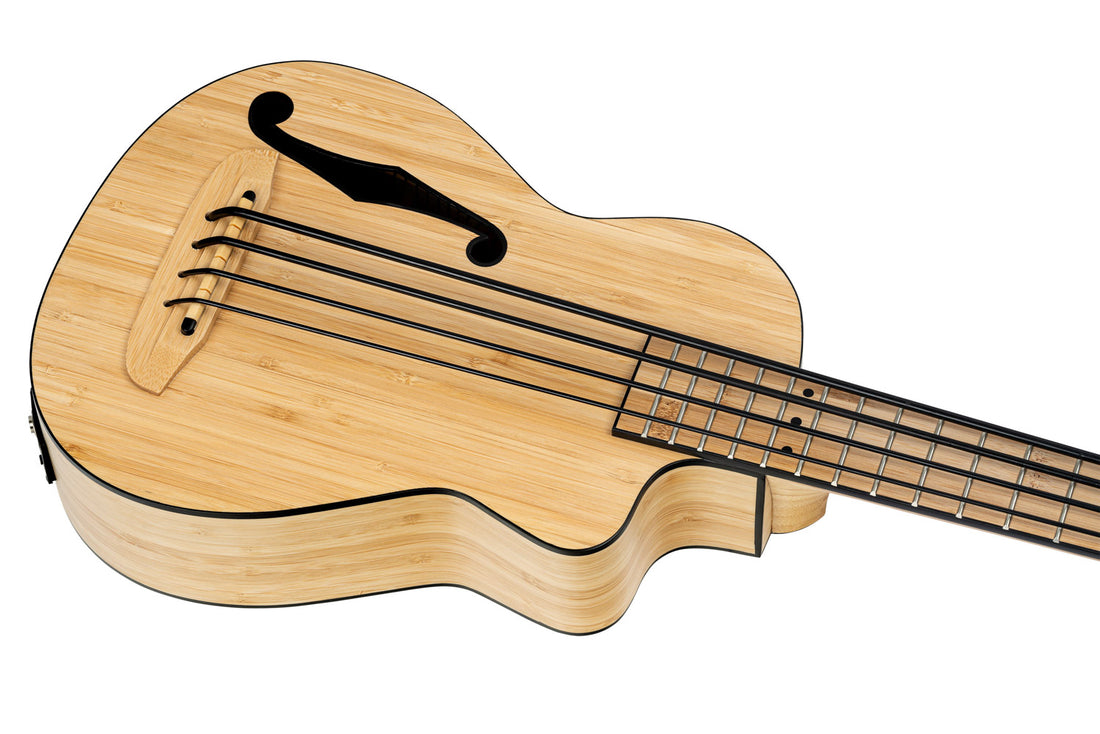
The ukulele bass is an instrument as new as it is misunderstood
Many ukulele players buy it thinking it is a bass ukulele, in the same way that there are bass saxophones, bass flutes and similar instruments. The connection is therefore not entirely illogical. Subsequently, ukulele basses and ukuleles are often displayed in the same display case at fairs and the like and in all kinds of advertising contexts. Which doesn't make the confusion any less. But now it's not called bass ukulele, but ukulele bass. It's a bass. In fact, the only connection this type of bass has to the ukulele is that it shares a scale/string length with the baritone ukulele. The idea for the ukulele bass came when you put bass strings on a baritone ukulele.
On the one hand, there are many ukulele players who buy ukulele basses and thus, somewhat by accident, come into contact with the wonderful world of the bass. Some of these are learning to play the bass. Others return the bass to the store again because it is not possible to play the ukulele on it. On the other hand, there are many bass players who avoid looking closely at ukulele basses because they think that it is not a bass, but a ukulele.
The ukulele bass's target group and areas of use
Many people think that it has something to do with the ukulele. The name comes from the fact that the first ukulele basses were modified baritone ukuleles. But today, some 20 years after the first commercial ukulele basses hit the market, this link is very slight. The ukulele bass has become an instrument of its own. But with a slightly unfortunate name, you might say.
A bass for children?
Both yes and no. A musical instrument is not automatically a child-friendly instrument just because it is small. Compare with violin, ukulele harmonica, etc. But by all means, a ukulele bass is easy to carry around and its short neck is grateful for small hands, so it can certainly be a good fit for young bass players.
The strings
Many people choose to play ukulele bass precisely for the soft strings. Others choose to play ukulele bass DESPITE the soft strings. Some simply choose the ukulele bass, precisely because of the soft strings.
There are many opinions about the silicone-like strings. They are both loved and hated. In the early years, there were only silicone strings for these basses - and with all due respect, the first generations of these strings were not very good. But in recent years a lot has happened on the ukulele bass string front. There are more and more established manufacturers who are starting to produce these and not least working to improve them - there are also completely new types of strings coming out at regular intervals. Not least strings wrapped with metal. Today, there are string sets that both look, sound like and feel like "real" strings when you play them.
A travel bass
Whatever one thinks of the strings and the short neck, one cannot deny that it is easier to travel and be mobile with a ukulele bass than with a traditional bass. Or a double bass for that matter. In most cases, you should be able to bring a ukulele bass as hand luggage on a plane.
Be careful with the cheapest basses!
Today, there are many manufacturers who make ukulele basses, for both good and bad. The good thing is that the limit of what a ukulele bass can actually be and perform is being pushed forward. But then we end up with cheap, almost unplayable basses as a byproduct. It is common to have tuning screws that do not work and piezo microphones that are poorly mounted. If you want to be sure of buying a good bass, then buy a brand you already know. And preferably avoid the very cheapest model.
Only 4-string basses?
There are almost only 4-string ukulele basses on the market. But there are a few 5-string examples. As demand increases and the status of the ukulele bass increases, it can be assumed that the 5-string ukulele basses will become more common.
Scale/string length
Most ukulele basses have a scale of 19-20 inches and most strings are adapted to this. But there are (and it is becoming more and more common) ukulele basses of around 23 inches.
Only with piezo microphones?
Until recently, only ukulele basses with piezo microphones existed, apart from the occasional home build. But now more and more models, from several manufacturers, are finding their way onto the market with magnetic microphones.
Semi-acoustic and solid
The boundary of what a ukulele bass is is constantly being moved. 10 years ago, a ukulele bass was a (semi) acoustic bass with a scale of 20 inches with rubber strings. Today we can see solid ukulele basses of 23 inches with steel strings and magnetic microphones.
1 comment
Har spilt fretless Kala-bass i mange år. Låter kule. Nesten like bra som kontrabassen min. Spiller i ukuleleorkester